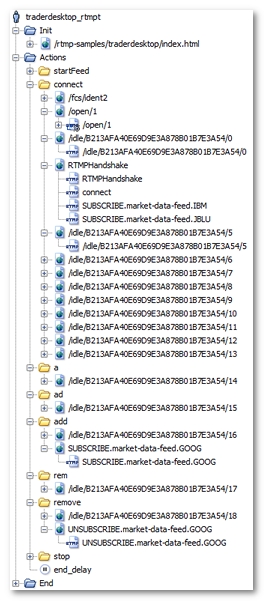
After the recording, a User Path using the RTMPT protocol is displayed as follows:
The following points should be noted:
/idle/ prefix have been recorded. These requests are polling requests.a, ad, and rem. Containers.Once processed by the Neotys Design Studio Post-recording wizard, the User Path is modified as follows:
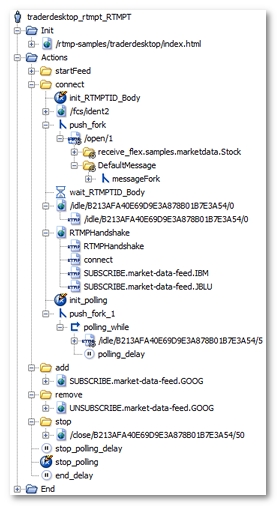
Neotys Design Studio has made the following noticeable changes:
/open/1 for example) has been placed in a secondary execution thread (push_fork) since it is a blocked process. A Variable Extractor (RTMPTID for example) has been configured to extract and re-inject the RTMPT session variable in each of the following requests: /idle/XXX, /send/XXX or /close/XXX. Execution of the main thread is put on hold until the RTMPTID session variable is retrieved, using the wait_RTMPTID_Body object. init_RTMPTID_Body resets the RTMPTID_Body variable, and the waiting time for a new value is considered on every Virtual User iteration./idle/${RTMPTID}/5 for example), reducing the number of requests considerably. If a Container becomes empty (a, ad, and rem for example), it is automatically deleted. For more information, see Polling requests.init_polling initializes the NL-stopPolling variable, with the false value, to have the polling function work on every Virtual User iteration./idle/${RTMPTID}/5 for example) has been placed in a loop (polling_while), which continues to loop until the NL-stopPolling variable generated by Neotys Design Studio becomes true. Lastly, the loop itself has been placed in a secondary execution thread using a fork action (push_fork_1 for example).receive_flex.samples.marketdata.Stock for example).polling_delay polling delay is the average of the time intervals between two polling requests in the original User Path.stop_polling variable modifier stops the polling loop by modifying the value of the NL-stopPolling variable.